Trust and Accountability in Hittite Bureaucratic Networks (ca. 1650–1190 BCE)
Tracing the provenance of clay sealings to understand officials, mobility and administrative trust across the Hittite realm.
← All research projects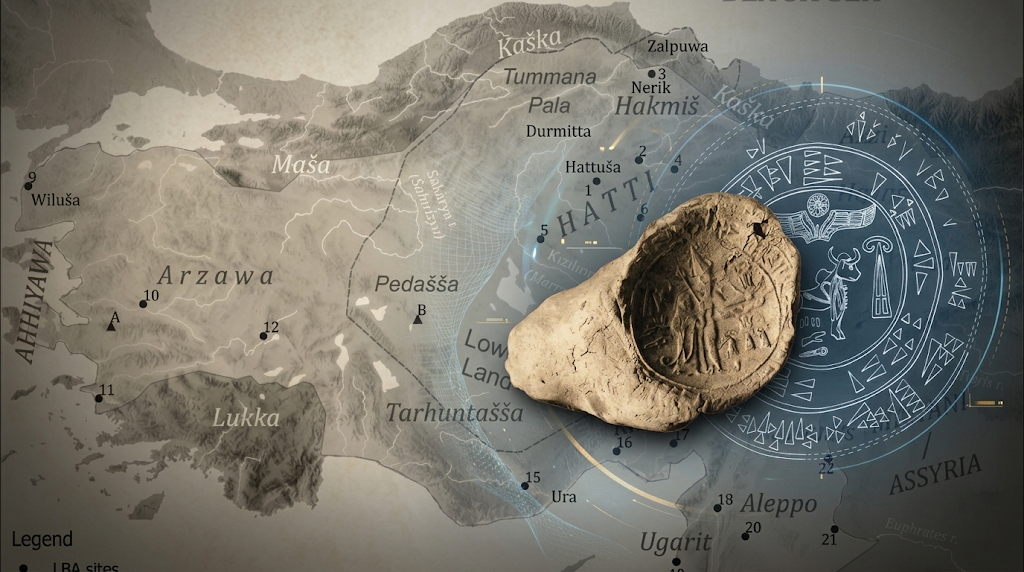
How did a Bronze Age empire, without modern means of communication, secure the integrity of its transactions? The Hittite state relied on clay sealings: lumps of clay attached to containers, doors and documents and impressed with the seals of officials. Once broken, they were archived as records of who had handled what. The largest such archive, the Westbau on Nişantepe in the Hittite capital Ḫattuša (Boğazköy), comprises more than 3,400 sealings. Where these sealings were made, and thus how far the network of officials extended beyond the capital, has never been investigated systematically.
The project combines history, archaeology and archaeometry to answer this question. My work concerns the geological foundation of the provenance analysis: together with colleagues from Pamukkale University (Baris Semiz), we sample and characterise clay deposits within a radius of about 100 km around Ḫattuša. Thin-section petrography and LA-ICP-MS define mineralogical and geochemical reference groups from around 350 clay samples. Against this reference framework, the sealings are analysed non-destructively by portable XRF, and machine-learning models assign them to probable source areas. Combined with the names and titles of the seal owners, the results show where Hittite officials worked, how they moved and how the administration organised trust across the realm.
Funded by the Czech Science Foundation (GAČR) and the Austrian Science Fund (FWF), 2026–2028.